
University of Victoria PhD Position in Active Tectonics and Earthquake Hazards
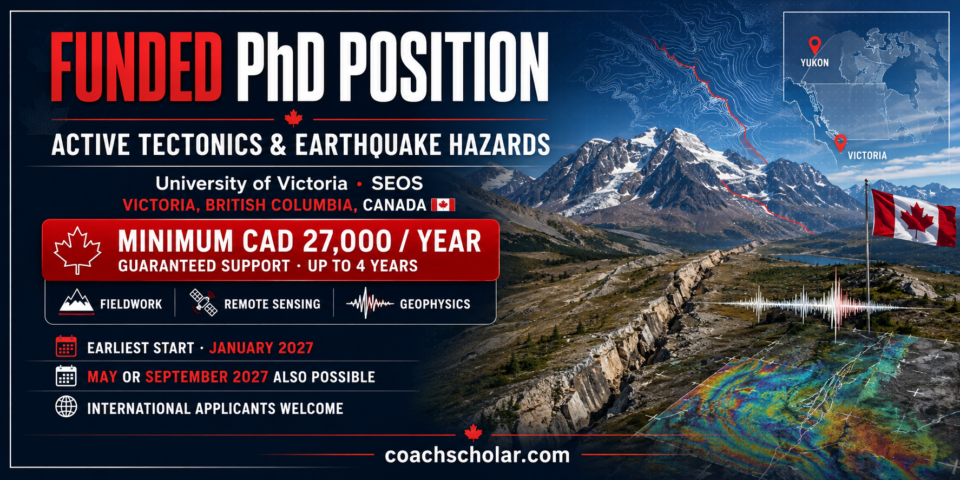
The University of Victoria PhD Position in Active Tectonics and Earthquake Hazards is a funded graduate research opportunity in Canada supervised by Dr. Edwin Nissen in collaboration with Dr. Theron Finley of the Yukon Geological Survey. The project investigates active faults and earthquake hazards across Yukon and British Columbia, combining remote fieldwork, geomorphology, geophysics, remote sensing, paleoseismology and seismic-hazard modelling. The earliest start is January 2027, with May or September 2027 starts also possible.
Opportunity
PhD Position in Active Tectonics and Earthquake Hazards
Type
Funded PhD Position / Graduate Research Opportunity
University
University of Victoria (UVic)
School
School of Earth and Ocean Sciences (SEOS)
Supervisors
Dr. Edwin Nissen — Professor and Canada Research Chair, University of Victoria
Dr. Theron Finley — Yukon Geological Survey; PhD graduate of UVic Earth and Ocean Sciences
Nissen’s expertise includes earthquakes, active tectonics, imaging geodesy, earthquake seismology and tectonic geomorphology. Finley’s research has used remote sensing, geodesy, seismology and field investigation to study active tectonics in Cascadia and Yukon.
Country
Canada 🇨🇦
Location
Victoria, British Columbia, Canada
The student will be based at UVic but will work closely with the Yukon Geological Survey and may spend part of each year, particularly during field seasons, working from its offices in Whitehorse, Yukon. Collaboration with researchers at the Geological Survey of Canada is also expected.
Study Level
PhD
The position is primarily intended for a doctoral student. Exceptional MSc applicants may also be considered, particularly those interested in subsequently transferring into the PhD programme.
Research Areas
- Active Tectonics
- Earthquake Hazards
- Earthquake Geology
- Paleoseismology
- Geomorphology
- Surficial Geology
- Remote Sensing
- Geospatial Analysis
- Geophysics
- Seismic Hazard Modelling
- Seismic Risk Analysis
- Quaternary Geochronology
- Active Fault Mapping
- Field Geology
- Tectonic Geomorphology
- Community-based hazard research.
Potential PhD Projects
The selected student may develop a project around one or more research themes.
Active Fault Mapping & Paleoseismology
Potential fault systems include:
- Tintina Fault in Yukon
- Eastern Denali Fault in Yukon
- Southern Rocky Mountain Trench Fault in British Columbia
- Newly identified scarps or surface ruptures discovered during the research.
Earthquake Hazard & Risk Modelling
Projects may involve deterministic or probabilistic seismic-hazard and risk analysis, including investigation of how local ground conditions influence earthquake hazards for communities in Yukon.
Geophysical Investigation
Research can also involve geophysical surveys across active faults to:
- Characterise fault geometry
- Image subsurface structures
- Measure seismicity
- Investigate strain rates
- Improve understanding of active deformation.
Fieldwork
Yes — fieldwork is a major component.
The project combines remote northern fieldwork with laboratory analysis, geophysical methods and computational hazard modelling. Students may conduct research in remote parts of Yukon and British Columbia and engage with local communities and First Nations.
Who Can Apply
The strongest candidates will have interests or experience in one or more of the following:
- Remote sensing
- Geospatial analysis
- Northern or remote fieldwork
- Geology
- Geophysics
- Geomorphology
- Surficial geology
- Quaternary science
- Earthquake geology
- Paleoseismology
- Seismic hazard assessment.
For normal direct admission to the UVic Earth and Ocean Sciences PhD, students with a recognised MSc degree can enter the PhD directly. SEOS normally expects at least a B+ average (UVic GPA 6.0) over the most recent 30 units of coursework. Exceptional applicants without an MSc can be considered for direct doctoral admission under UVic rules.
International Applicants
Yes.
UVic accepts international graduate students, and this specific recruitment announcement does not state a citizenship restriction. International applicants must meet the same academic requirements and applicable English-language requirements.
Language Requirements
English is the language of instruction at UVic.
Applicants who need to demonstrate English proficiency can currently meet the university requirement through tests including:
- IELTS Academic: 6.5 overall, no section below 6.0
- TOEFL iBT: 4.5 overall with no section below 4.0 for tests taken after 21 January 2026
- Other accepted tests include CAEL, Cambridge C1/C2, MET and PTE.
Applicants may be exempt if they hold a degree from a recognised institution where the language of instruction was English or meet another UVic exemption.
Funding
Funded PhD Position
The School of Earth and Ocean Sciences guarantees MSc and PhD students a minimum financial-support package of:
CAD 27,000 per year
For PhD students, the minimum funding guarantee normally applies for four years, provided satisfactory academic performance and research progress are maintained. Funding can combine research assistantships, teaching assistantships, UVic fellowships and external awards.
Important Funding Note
I would not advertise this as “Full Tuition + Stipend”.
SEOS explicitly states that graduate students pay their own tuition and fees; these are not automatically paid separately by the department or supervisor. The CAD 27,000 minimum represents guaranteed financial support rather than a separate tuition waiver plus living stipend.
For CoachScholar, the safest wording is:
Funding: Minimum CAD 27,000/year guaranteed support for PhD students
Duration
The UVic Earth and Ocean Sciences PhD has an expected duration of approximately:
4 years
Start Date
Possible starting dates are:
- January 2027 — earliest anticipated start
- May 2027
- September 2027.
Application Requirements
For the UVic Earth and Ocean Sciences PhD application, applicants are required to provide:
- One-page statement of intended study
- Current CV / résumé
- Names and email addresses of two references
- Post-secondary academic transcripts
- English-language proficiency evidence, where required.
Contact Supervisors First
Prospective applicants are strongly encouraged to contact the supervisors before submitting the formal UVic application.
This allows the research team to discuss the applicant’s interests, experience and potential project fit.
Dr. Edwin Nissen:enissen@uvic.ca
Dr. Theron Finley:Theron.Finley@yukon.ca
Application Method
After discussing research fit with the supervisors, candidates submit the formal application through the University of Victoria Faculty of Graduate Studies online system. UVic requires applicants to identify a prospective supervisor, and that faculty member must agree to supervise and recommend admission.
Application Fee
Current UVic graduate application fees are:
- CAD 142.50 if all application documents originate within Canada
- CAD 183.00 if any application documents originate outside Canada.
Ready to Apply?
Review the details above, then use the links below to apply or visit the official page.
Related Other

Sheffield Hallam University – Advanced Wasteform Development for Challenging Nuclear Waste Streams (PhD)
Sheffield Hallam University


Loughborough University – Spectrally Pure Topological Microcombs PhD (Ref: AQ/PH/2026-02)
Loughborough University